Welcome to HED Group

Loading...

Tổng tiền:

Cart

Trang chủ

Loading...

Danh mục sản phẩm

Loading...

Sản phẩm bán chạy

PAC Chemical

HED GROUP JSC

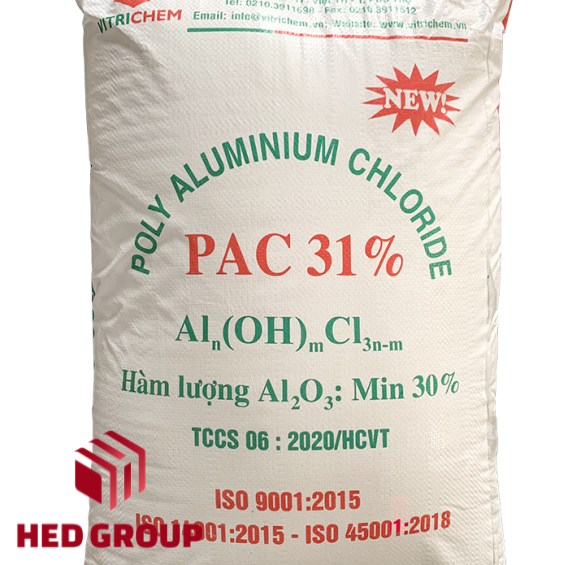
Hed Group is a reputable distributor of PAC water treatment chemicals. With extensive experience and a professional technical team, Hed Group is committed to providing customers with high-quality products and the best price policies.

PAC 31% water treatment chemical (PAC coagulant) is a type of high-molecular-weight aluminum salt that is widely used in many countries around the world, including Vietnam, China, Japan, etc. It can replace aluminum sulfate in wastewater treatment, domestic water treatment, and especially in drinking water treatment.

Liên hệ

Some basic information about PAC 31% (Poly Aluminium Chloride) chemical:

Poly Aluminium Chloride (PAC) is a type of high-molecular-weight aluminum salt that exists in polymer form. Currently, PAC is produced in large quantities and widely used in advanced countries to replace aluminum sulfate in treating domestic and industrial wastewater, with important applications such as:

  • Treatment of domestic water, industrial water.
  • Treatment of industrial wastewater.
  • Aquaculture water treatment.
  • Paper industry coagulant.
  • Other applications: Used for treating wastewater containing suspended solids such as wastewater from ceramic, brick, paper, dyeing, seafood processing plants, export processing zones, wastewater from the electronics industry, households, etc.

1. What is PAC chemical?

PAC chemical, PAC coagulant, poly aluminium chloride chemical, poly aluminium chloride (PAC), PAC abbreviation, are all questions about PAC.

PAC water treatment chemical is the abbreviation for poly aluminium chloride - Molecular formula [Al2(OH)nCl6-n]m. This is a coagulant chemical, a flocculant in water treatment, wastewater, aquaculture water treatment, helping to coagulate floc compounds and suspended solids, remove organic matter, bacteria, viruses in water.

Explanation of what is PAC flocculant? How is flocculant used in wastewater treatment, domestic water?

PAC water treatment chemical contains aluminum content up to 28 - 32% which effectively coagulates impurities in water without harming the environment. Currently, PAC chemicals are widely manufactured and used in Asian countries as a complete substitute for aluminum sulfate.

2. Key characteristics of PAC:

PAC coagulant exists in liquid and powder forms, so the color and chemical properties of PAC differ:

  • PAC powder is yellow-orange, ivory white, completely soluble in water, and can be stored for a long time under normal conditions.
  • PAC liquid is brownish-yellow, usually stored in bottles or plastic cans for longer preservation.

PAC flocculant has the ability to completely remove dissolved organic and insoluble organic matter and heavy metals better than aluminum sulfate.

3. Advantages of PAC 31% water treatment chemical:

PAC water treatment chemical has many superior advantages over aluminum sulfate, specifically:

  • PAC increases water clarity, extends filtration cycles, and effectively improves water quality after filtration.
  • The Aluminum Chloride in PAC compound has partially reacted with alkali, so when dissolved in water, PAC will have lower acidity, meaning that the pH will not drop suddenly, convenient for pH adjustment, saving chemicals used to increase alkali and accompanying equipment such as dosing pumps and chemical tanks compared to using aluminum sulfate.
  • PAC works best at pH range from 6.5 - 8.5 because at this time, all heavy metal ions are precipitated and sink to the bottom or adhere to floc particles.
  • Using PAC flocculant minimizes equipment corrosion.
  • PAC can be easily transported, stored, and dosed.
  • PAC can dissolve in water at any ratio.
  • High sedimentation efficiency compared to aluminum sulfate, about 4 - 5 times.
  • Fast flocculation time.
  • Low dosage of PAC, large floc, easy settling.
  • Simple to use, no need for support equipment, or very little auxiliary chemicals are needed.

4. Disadvantages of PAC water treatment chemical:

In addition to the advantages, PAC water treatment chemical still has some disadvantages such as:

  • PAC is highly effective, just using a low dosage can treat a large volume of wastewater, so using an overdose will cause the phenomenon of floc redissolution.
  • The Chloride content in PAC flocculant will promote corrosion at sludge sedimentation sites.

5. Important applications of PAC water treatment chemical:

Poly aluminium chloride (PAC) chemical is widely used as an industrial precipitant and applied in various industrial sectors. PAC is significant in treating turbid water, dirty water, creating high-quality water sources for production and domestic use. Therefore, PAC flocculant is applied in most of the following technological processes:

  • PAC water treatment chemical for treating wastewater containing suspended solids such as industrial wastewater from dyeing, ceramics, brick, paper mills, seafood processing plants, animal slaughterhouses, household wastewater, etc.
  • PAC flocculant, flocculate suspended solids to treat domestic water, industrial water, suitable for water supply plants, swimming pools, water supply stations, etc.
  • Application in domestic water filtration, drinking water directly from rivers, lakes, canals.
  • PAC water treatment chemical in aquaculture ponds (especially fish farming ponds, shrimp farming ponds).

The dosage of PAC flocculant depends on the suspended solids content and the nature of the wastewater to be treated.

6. The most accurate way to prepare PAC water treatment chemical:

The PAC water treatment chemical preparation method is quite simple, just remember the following formulas:

  • Prepare PAC into a 5% - 10% solution and then pour it into the water source to be treated.
  • PAC dosage when treating soft water: 1 - 10g/m3 of PAC (depending on the turbidity of raw water).
  • PAC dosage when treating wastewater for paper mills, dyeing and weaving factories, seafood processing plants, food factories, animal slaughterhouses, domestic wastewater, etc.: 20 - 200 g/m3 depending on the characteristics of the wastewater to be treated.

Sản phẩm liên quan